Severn Partnership – Vessel Systems Calibration Survey Summary:
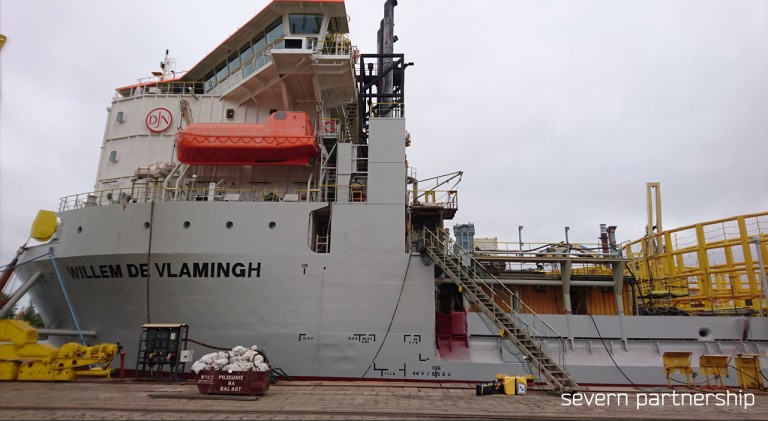
After two previous jobs from a new client, Jan De Nul Group, we were asked to conduct a vessel systems calibration survey on the cable laying vessel Willem De Vlamingh. It was a requirement from their client that a British, RICS accredited survey firm conduct the confirmation checks and based on the successful completion of the two previous jobs we were once again approached.
Project Overview:
Brief of the job was to confirm the ship Gyro’s, MRU’s (Pitch and Roll sensor), GPS and QINSy (Local network coordinates system calculator) were all operating within the tolerances set for the upcoming job. Ground control had been established by a local firm and reduced to UTM zone 34 coordinates for ease of comparison between the Calculated data (measured by us) and Observed data (measured by the vessel’s systems). The total station clocks were synchronised with the vessel recording system and the process could begin.
For the gyrpo, pitch and roll checks pairs of measurements were taken continuously for ten minutes at strategic points to generate baselines from which comparisons could be made. The baseline values were then compared to the corresponding vessel system values to get a C-O or difference which would either confirm the system was in tolerance or allow the crew to make any adjustments.For the GPS and QINSy system measurements were taken, again for ten minutes, at either the GPS antenna’s themselves or at Datum Plates on the vessel. Once the measurements were reduced the results could again be compared with the vessels systems to get a C-O to either confirm the tolerance or allow for adjustments to be made.
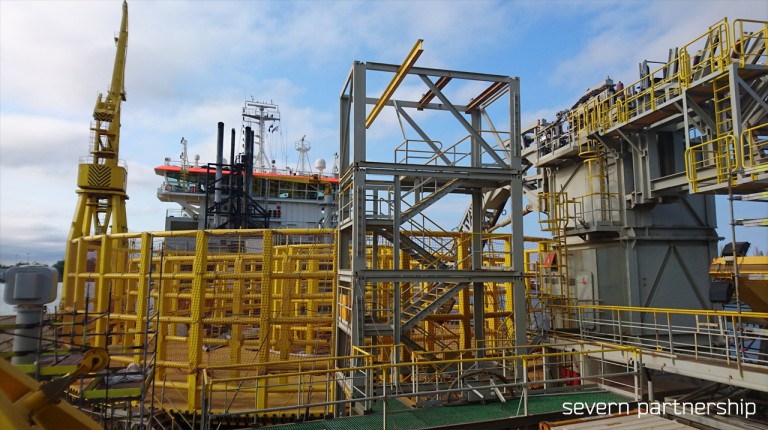
As an extra service while on site we were able to ‘fix’ some points on a new structure that had been installed as part of the yard visit, this were given to the client on site to get new Datum Plates put in.
Challenges:
Logistics, vessel was in Poland. Travel was by air, economising luggage by taking only critical kit was necessary and getting the job done in one day as returning to site was not an option. Maritime industry is time critical, vessel was leaving port soon after the job was completed.
Benefits:
We were able to reduce a single shot of data for each of the checks carried out to make an on site comparison to evaluate that there were no unexpected issues so both the client and we were happy the data was as expected and no unexpected surprises would happen when we prepared the report.
Deliverables:
A detailed report confirming the C-O results for the various systems. Some basic analysis was carried out displaying the measurements to graphically demonstrate the differences in the various systems.